What to take away
- Use a validated suitable monitor and careful measurement technique.
- Bring a record to your clinician rather than changing treatment yourself.
- Very high readings and concerning symptoms require prompt action.
General education for adults. AI assisted content; not professionally medically reviewed. Sources are linked throughout. For advice about your health, speak with a qualified clinician. Our editorial policy.
Understand the two numbers
Blood pressure is recorded as systolic pressure over diastolic pressure, in millimeters of mercury. The upper number relates to pressure when the heart contracts; the lower number relates to pressure between beats. A single reading does not by itself establish a high blood pressure diagnosis. [1]
Use your clinician’s instructions for interpretation, targets, and follow-up. A home record can add useful information, but technique, device suitability, and the measurement pattern matter. This article explains general principles for adults; pregnancy, children, and particular medical conditions may require different advice. Do not change medication based on an isolated reading or treat a normal number as proof that prescribed treatment is unnecessary.
Use a suitable monitor and cuff
The American Heart Association recommends a validated automatic upper-arm device with a cuff that fits your arm. Bring it to a medical appointment to check technique and compare its readings with the office equipment. [3]
Ask about suitability if you are pregnant, have an irregular heart rhythm, or have another circumstance that affects measurement. A product’s popularity or a phone app’s appearance does not establish accuracy. Follow the device instructions, including cuff placement and maintenance. If you cannot obtain or use a home monitor, discuss another option with your care team. Access and usability matter more than collecting a large amount of questionable data.
Prepare before you measure
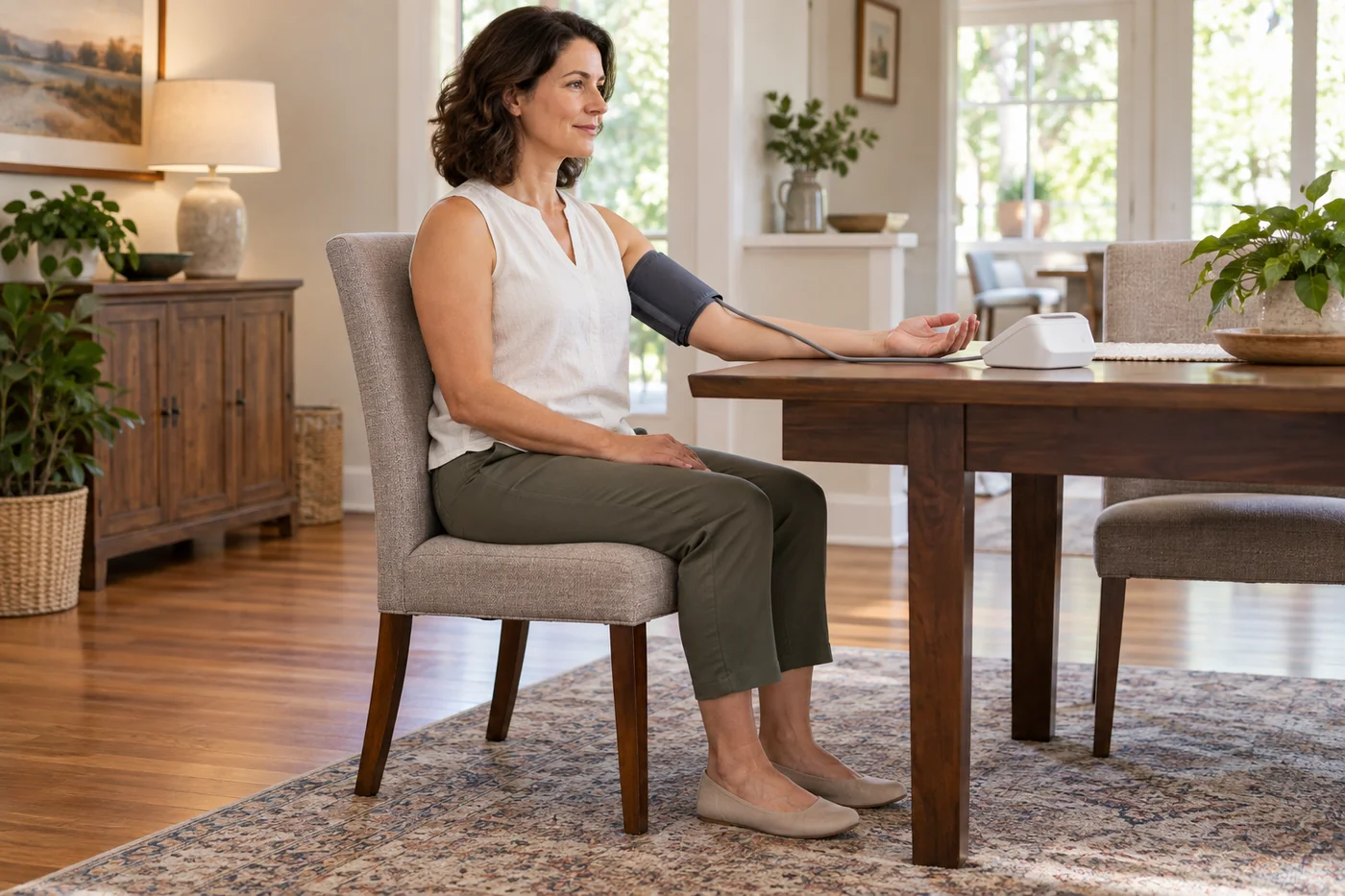
CDC advises avoiding smoking, caffeine, alcohol, and exercise in the 30 minutes beforehand, emptying your bladder, and sitting quietly for at least five minutes. Keep your back supported, feet flat, legs uncrossed, and arm supported at chest height; place the cuff on bare skin and do not talk. [2]
Set up a chair and surface that allow this position rather than taking a rushed measurement while standing or talking. If a disability makes the standard position difficult, ask for adapted instructions and record the position used. A careful routine makes the numbers easier to interpret. Technique problems are a reason to review the setup, not a reason to ignore an unexpectedly high reading.
Keep a useful record
Follow the schedule recommended by your clinician. The American Heart Association advises taking two readings a minute apart during home measurement and recording the results. [3] Include the date, time, readings, and relevant notes such as symptoms or a missed dose.
Bring the record or device memory to appointments. Avoid measuring repeatedly throughout the day solely to chase a reassuring number unless instructed. If readings are inconsistent, review technique and discuss the pattern. USPSTF recommends out-of-office measurements for diagnostic confirmation when appropriate; that process should be directed by clinical care. [4] A home log is evidence for a conversation, not an invitation to diagnose or treat yourself.
Know when a high reading is urgent
If the upper number is higher than 180 or the lower number higher than 120, wait at least one minute and measure again. If it remains that high, contact your health professional immediately. If such a reading comes with chest pain, shortness of breath, weakness, numbness, vision changes, or trouble speaking, call 911. [1]
Do not wait for a diary to be complete or try to lower the number with exercise. Serious symptoms can require emergency help even when you do not have a blood pressure reading. Pregnancy can have different urgent thresholds and warning symptoms, so follow your maternity care instructions. This general article cannot provide an individualized emergency assessment.
Use lifestyle changes alongside your treatment plan
Ask your clinician which changes are relevant to your overall risk and whether they recommend a structured eating plan, activity changes, or other support. Choose manageable steps and keep follow-up appointments. If you take prescribed medicines, ask about side effects, monitoring, and what to do after a missed dose.
Do not stop treatment because a home reading improves; the improvement may reflect treatment working. Equally, do not double a dose or take someone else’s medicine for a high reading. Food, sleep, stress management, and movement can belong in a broader care plan, but they do not replace indicated treatment. The most useful home routine combines accurate measurement, clear instructions, and timely communication with your care team.
Common practical questions
Should I share every reading with my clinician immediately?
Follow the communication plan you agree on, including urgent instructions. A routine log may be reviewed at a scheduled visit, while very high readings or concerning symptoms need faster action. Ask exactly how to send records and whom to contact after hours. Do not assume an app automatically alerts the care team.
What if I cannot use the standard setup?
Explain the limitation and ask for adapted measurement instructions. Mobility, arm size, or other circumstances may affect the appropriate device and position. Record the method used so the clinician can interpret the readings. Do not improvise a technique and assume the result is equivalent. Suitable equipment and professional guidance are more useful than frequent measurements taken under inconsistent conditions.
Sources & references
- American Heart Association: Understanding Blood Pressure Readings. Updated August 14, 2025. Source link checked October 11, 2026.
- CDC: Measuring Your Blood Pressure. Source link checked October 11, 2026.
- American Heart Association: Home Blood Pressure Monitoring. Updated August 14, 2025. Source link checked October 11, 2026.
- USPSTF: Hypertension in Adults: Screening. April 27, 2021. Source link checked October 11, 2026.
Research can change. These sources support the claims cited in this article, rather than every suggested example. Our action plans are adaptable editorial examples.

Elena Morales
A fictional editorial persona covering lifelong health habits and preparation for preventive care conversations.
Fictional editorial persona · AI generated portrait · No clinical credentials