What to take away
- The relevant research ingredient is quantified nitrate, not red color or scoop size.
- Beetroot juice studies do not validate every retail powder.
- Verify composition and suitability before pursuing a performance or blood-pressure goal.
General education for adults. AI assisted content; not professionally medically reviewed. Sources are linked throughout. For advice about your health, speak with a qualified clinician. Our editorial policy.
This article contains affiliate links. As an Amazon Associate I earn from qualifying purchases. Links are optional and do not change our interpretation of evidence.
Beetroot powder is not automatically a research-matched nitrate product
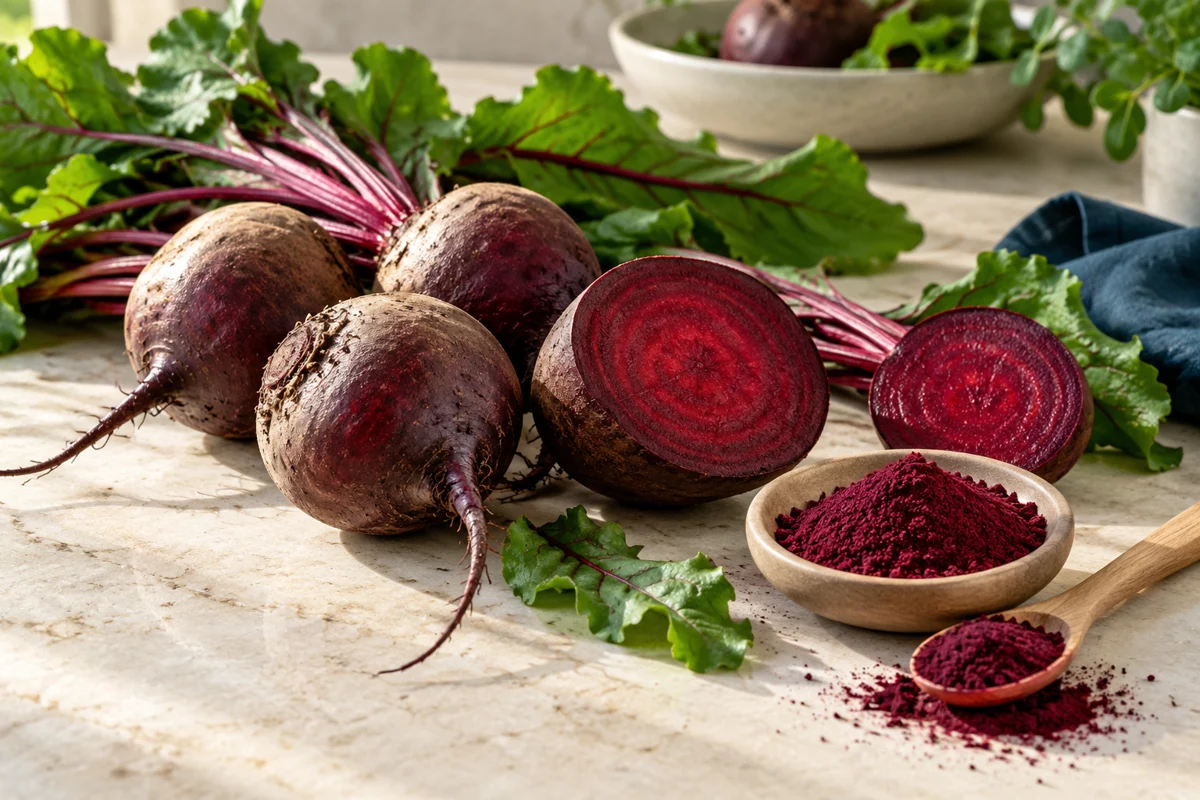
Beetroot powder may be a convenient food ingredient, but its red color and serving weight do not tell you how much nitrate it supplies. Most performance questions concern dietary nitrate, not a generic scoop of beet powder. A product can contain beetroot without providing the standardized amount used in a particular exercise study. That is the first distinction to make before expecting improved endurance or buying a larger bag.
The supplied listing identifies Micro Ingredients Organic Beet Root Powder, so “Beat Powder” does refer to beetroot in this case. The word organic in the listing is a claim that needs current certification verification; it is not evidence of a performance benefit. We have not treated the listing name as proof of the exact batch’s nitrate content, contaminant testing, or clinical effectiveness. Those remain separate questions.
How the nitrate idea works
Dietary nitrate can enter a nitrate–nitrite–nitric oxide pathway involving oral bacteria and body tissues. Nitric oxide has roles in blood-vessel function and exercise physiology. That provides a plausible mechanism for studying nitrate-rich beetroot preparations; it does not prove that every powder has an effective dose or that a person will experience a particular result. A biological pathway is the beginning of a research question, not the final answer. Jones: dietary nitrate and exercise performance
Make the mechanism practical by asking what the product actually measures. “Five grams of beetroot” and “a measured amount of nitrate” describe different things. Drying, growing conditions, formulation, and serving size can affect the comparison. If the label only supplies total powder weight, you cannot calculate a research-equivalent nitrate serving from that number alone. Do not invent a conversion factor or assume that darker powder is stronger.
Where evidence is promising and where it remains uncertain
Studies of nitrate-rich beetroot preparations have investigated endurance, oxygen cost, repeated effort, and strength-related outcomes. Findings vary with training status, exercise type, formulation, and protocol. NIH describes the evidence as limited and mixed rather than a universal performance guarantee. NIH review of exercise supplements That is particularly important when an advertisement translates a small laboratory difference into a promise about every workout.
A meta-analysis in healthy male participants reported modest improvements in some muscular-endurance outcomes, but that does not establish equal benefit for all ages, sexes, products, and training routines. Review of beetroot-based supplements and muscular performance A separate blood-pressure review examined nitrate-rich juice in people with hypertension. Review of beetroot juice and hypertension It should not be read as permission to replace blood-pressure treatment with an unstandardized powder.
A useful person-to-purpose match
A recreational endurance athlete with a stable training program may have a specific performance question worth discussing with a sports dietitian. A person who simply enjoys adding beetroot to a smoothie may have a food preference rather than a supplement protocol. Those uses should not be presented as the same clinical goal. If the intended use is food, assess taste, convenience, serving information, and tolerance without claiming a special medical effect.
Someone hoping to compensate for inadequate sleep, skipped meals, or erratic training is unlikely to get a complete solution from this ingredient. Write down the actual problem: running out of energy because lunch was missed, lacking a gradual training plan, or struggling with recovery. Addressing that problem directly is more useful than adding several powders at once. Our nutrition tools can help explore meals, but their estimates are not a medical nitrate prescription.
Doses in studies are not instructions for this bag
Research often reports nitrate as an amount or concentration, sometimes together with a specified juice volume. Those quantities cannot be replaced by an assumed number of powder scoops. Reviews have found meaningful differences in nitrate delivery between commercial products, reinforcing the need for an actual measurement. Dietary nitrate review: formulation and product quality No research-equivalent serving of the supplied powder can be established without a reliable nitrate value.
If a qualified professional recommends a defined protocol for a suitable adult, ask which product specification matches the evidence and how the response will be evaluated. Follow the actual product directions and avoid increasing intake simply because the first attempt produces no obvious feeling. Introducing a new concentrated ingredient immediately before an important event also makes it harder to separate gastrointestinal tolerance from performance. The article offers questions, not a personalized competition-day schedule.
Precautions: food-derived does not mean suitable for everyone
Discuss concentrated beetroot products with your clinician if you have low blood pressure, use blood-pressure medicines, have kidney disease, have been told to limit potassium or oxalate, or have a history of relevant kidney stones. The appropriateness depends on the actual product, serving, diet, and medical history. Do not infer a safe potassium or oxalate amount from a marketing description that does not provide one.
Stomach discomfort is a reason to reconsider the amount and seek advice when persistent. Beet pigments can change the color of urine or stool, but do not use that explanation to dismiss possible bleeding, pain, or other concerning symptoms. An unexplained change may need assessment. This guide cannot diagnose the cause. Do not adjust prescribed medicines to accommodate a supplement, and obtain individual guidance during pregnancy, breastfeeding, or treatment for a medical condition.
Read the label as an ingredient investigation
Start with the full ingredient list: is it only beetroot, or does it include other powders, sweeteners, flavorings, or stimulants? Confirm the serving measure, gram weight, allergen information, and storage instructions. If nitrate is advertised, look for its quantified amount, test method, and whether the value is batch-specific. A vague statement about naturally occurring nitrates is not the same thing as a guaranteed concentration.
For an organic claim, check the named certifier and exact current product record rather than treating the seller’s wording as independent confirmation. For laboratory claims, request a certificate that matches the batch and identifies the laboratory and results. FDA explains that supplements are not generally approved for effectiveness before marketing. FDA supplement overview A seller’s positive reviews cannot fill a missing nitrate assay or establish suitability for a health condition.
Use food options and a repeatable routine as the baseline
Whole cooked or raw beets can be part of meals if you enjoy them and they fit your needs. They are not a precisely standardized nitrate intervention either, but they do not need to be one to be an ordinary food. A powder may reduce preparation work; compare that convenience with its price and how often you will use it. You do not have to make every ingredient earn a performance claim.
If trying the powder as food, choose a familiar recipe and follow the label rather than turning the first serving into an elaborate stack. Note the amount used, the meal, and any discomfort. Keep other changes limited enough that you can understand the experience. For general eating structure, start with the balanced-meal guide. A reliable meal before training can be a more immediate priority than seeking a marginal effect from an uncertain supplement.
The supplied product: label details and open questions
Micro Ingredients Organic Beet Root Powder, 4 lb
Retailer identity and label descriptions were checked October 19, 2026. They are not clinical evidence, proof of an authentic delivered batch, or results from personal product testing. Packaging can change.
| Listing identity | Amazon ASIN B01N20ON39 |
|---|---|
| Serving or specification | The listing identifies a 4 lb beetroot powder, while one ingredient field calls it concentrated beetroot juice powder. No quantified nitrate content was verified; no research-equivalent scoop can be assigned. |
| Composition or material | Retail text describes an organic beet ingredient, but powder-versus-juice wording is inconsistent. Confirm the exact ingredient, serving weight and any quantified nitrate claim. |
| Testing and certification | Independent certification and current batch-specific laboratory results for this exact supplied item were not confirmed. Manufacturer or retailer testing claims are not treated as independent verification. Organic wording is attributed to the listing; an exact current product-scoped organic certificate was not independently confirmed. |
If the category fits a genuine need, you can inspect the Micro Ingredients Organic Beet Root Powder, 4 lb listing and current label on Amazon (affiliate link). Compare it with the evidence and alternatives above; this is an optional label-comparison link, not a claim that we tested or clinically validated the product.
Common questions
Does organic mean more nitrate? No. An organic certification addresses production standards, not a guaranteed nitrate concentration or superior exercise outcome. Check the specific claim rather than attaching an unrelated meaning to the word organic.
Can beetroot powder replace blood-pressure medicine? No. Research on selected nitrate-rich preparations is not a substitute for diagnosis, monitoring, or prescribed treatment. Ask a clinician before concentrated use if medicines or blood-pressure concerns are involved.
Is a scoop equivalent to beetroot juice in a trial? Only a measured, relevant composition could support that comparison. Powder weight and juice volume alone do not establish equivalence. If the required nitrate information is unavailable, the honest conclusion is that the research dose cannot be matched.
Affiliate reminder: this article includes an Amazon affiliate link. As an Amazon Associate I earn from qualifying purchases. Buying a product is not required to benefit from this guide.
Want to understand your meals in numbers? Explore the macro calculator and meal planner. Tracking is optional and may not suit everyone.
Sources & references
- Jones: Dietary Nitrate Supplementation and Exercise Performance. 2014. Source link checked October 19, 2026.
- NIH Office of Dietary Supplements: Dietary Supplements for Exercise and Athletic Performance. Source link checked October 19, 2026.
- Evangelista JF, Meirelles CM, Aguiar GS et al.: Effects of Beetroot-Based Supplements on Muscular Endurance and Strength in Healthy Male Individuals: A Systematic Review and Meta-Analysis. 2024. Source link checked October 19, 2026.
- Grönroos R, Eggertsen R, Bernhardsson S et al.: Effects of beetroot juice on blood pressure in hypertension according to European Society of Hypertension Guidelines: A systematic review and meta-analysis. 2024. Source link checked October 19, 2026.
- Dietary Nitrate Supplementation and Exercise-Related Performance. 2021. Source link checked October 19, 2026.
- U.S. Food and Drug Administration: FDA 101 — Dietary Supplements. Source link checked October 19, 2026.
- Amazon product listing: Micro Ingredients Organic Beet Root Powder, 4 lb (retailer description, not efficacy evidence). Source link checked October 19, 2026.
Research can change. These sources support the claims cited in this article, rather than every suggested example. Our action plans are adaptable editorial examples.

Maya Rivera
A fictional editorial persona for My Wealthy Body’s nutrition coverage, translating sourced guidance into approachable meals and everyday food choices.
Fictional editorial persona · AI generated portrait · No clinical credentials