What to take away
- Choose a mat for grip, space, cushioning, and your actual activity.
- Yoga-program research does not establish benefits from a particular mat.
- Use suitable instruction and adaptations; extra padding does not make every pose safe.
General education for adults. AI assisted content; not professionally medically reviewed. Sources are linked throughout. For advice about your health, speak with a qualified clinician. Our editorial policy.
This article contains affiliate links. As an Amazon Associate I earn from qualifying purchases. Links are optional and do not change our interpretation of evidence.
A mat supports practice; it is not the source of every benefit
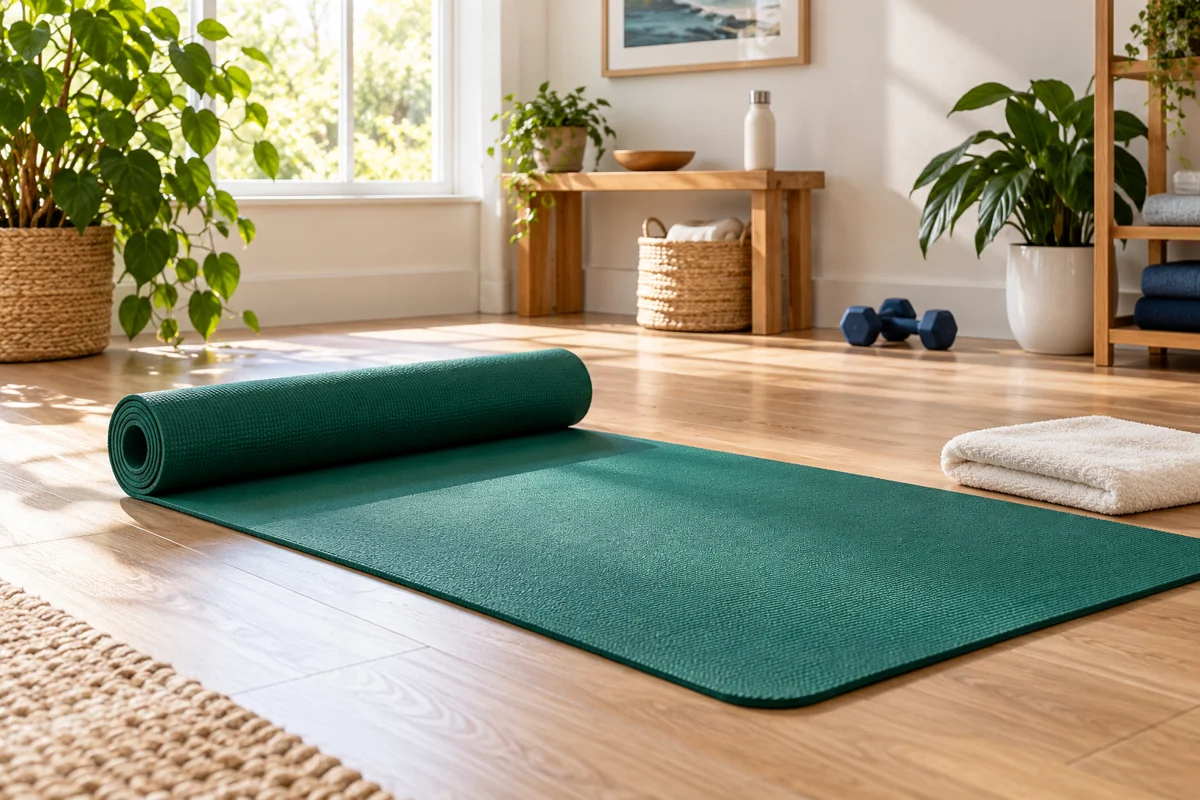
A useful yoga mat gives you a consistent surface that fits your body, floor, and chosen activity. It does not need to promise detoxification, hormone balance, or a special healing material. Grip, stable footing, enough room, comfortable contact, and maintenance instructions are more practical starting points. The best mat is one that works safely for the way you actually move, not necessarily the thickest, most expensive, or most heavily promoted option.
The supplied link identifies a Gruper mat listing with a 6 mm description and color options. The current size, material, care instructions, and exact delivered version should be checked before use. An “eco-friendly” description is a marketing claim unless supported by identifiable standards relevant to the product. This article has not tested that mat’s traction, composition, durability, or environmental footprint, and does not treat a listing image as a laboratory result.
Separate yoga research from mat advertising
Yoga research concerns practices and programs, not proof that a particular retail mat creates health benefits. NCCIH describes evidence for several uses while emphasizing variation between styles, studies, and individual needs. NCCIH: yoga effectiveness and safety A review of yoga for chronic low-back pain and a trial comparing structured yoga with physical therapy provide context for that specific condition; neither validates every home video, pose, or mat. Review of yoga for chronic low-back pain Saper and colleagues: structured yoga trial
This distinction is useful when a mat advertisement lists benefits belonging to movement generally. Buying the surface does not reproduce a supervised program. If you have back pain or another condition, decide on a suitable activity with a professional first, then choose equipment that helps you carry it out. A comfortable mat can reduce friction in the routine without being described as treatment.
Start with your activity and available space
Write down what you intend to do: gentle floor movement, a beginner class, standing balance, kneeling exercises, or a combination. Measure the area where you can roll out the mat fully without blocking a doorway or contacting furniture. Include space around the edges so hands, feet, and a controlled transition can extend beyond the mat when needed. A mat that fits the room only when folded may not provide the setup you intended.
Consider your body size and the positions you will use. You should not need to rush a transition to avoid an obstacle. If a shared room is the only option, decide where the mat will dry and be stored so that laying it out remains easy. If you travel to classes, compare weight and carrying convenience with your needs at home. There is no single dimension that fits every person or practice.
Grip is a relationship between several surfaces
The top surface must work with your hands or feet, while the underside must work with the actual floor. A mat can feel grippy in a shop yet slide on a polished floor at home. Sweat, dust, cleaning residue, and wear can change the experience. Test ordinary, easy positions first in a clear area rather than beginning with a demanding pose to discover whether either surface moves.
Do not assume that an absorbent towel solves every traction problem; a loose layer can create its own movement. Follow the manufacturer’s recommendations for compatible use and cleaning. If the mat curls, bunches, or slips, stop and correct the setup rather than gripping harder through a difficult position. Stable contact is a practical equipment requirement, not a promise that the mat can prevent every fall or strain.
Cushioning and stability can pull in different directions
A softer surface may feel more comfortable for some knees or elbows, but more softness is not automatically better for balance. Consider the activity, the floor beneath it, and how much the material compresses under you. A person who mainly does supported floor work may prefer a different feel from someone practicing standing transitions. Thickness alone does not describe firmness, grip, or durability.
If one position feels uncomfortable, changing the pose or adding an appropriate support under instruction may make more sense than buying an increasingly thick mat. Do not stack unstable layers or assume extra padding makes a painful movement safe. Ask an instructor or physical therapist about adaptations when joint pain or limited mobility is involved. The mat should support the activity you can do comfortably, rather than become a way to force a position that is unsuitable.
A simple first-session checklist
Lay the mat flat on a clean, appropriate surface. Remove nearby obstacles and check that corners do not curl into your path. Wear clothing that lets you move without catching on the mat, and begin with easy positions you already understand. Before adding balance or a transition, notice whether the top and bottom surfaces remain secure. Keep breathing comfortably and give yourself time to change position.
This is an editorial equipment check, not a complete yoga lesson. A qualified instructor can help with positioning and modifications, especially if you are new to the activity. NCCIH advises appropriate instruction and individual adjustments for health circumstances. NCCIH: safety and suitable instruction You can start with a short, comfortable practice without attempting a difficult sequence. Stop for concerning pain, dizziness, numbness, or a feeling that you cannot control the next movement.
Use extra care when health conditions change the task
Pregnancy, balance difficulty, osteoporosis, a recent procedure, significant joint problems, and other conditions can change which poses or transitions are suitable. The issue is not whether a mat is marketed as beginner-friendly; it is whether the activity matches your circumstances. Discuss adaptations with a qualified professional and tell an instructor about relevant restrictions before class.
Do not use a mat or an online routine to self-treat persistent pain, unexplained weakness, or neurological symptoms. General exercise-safety advice favors an appropriate starting level and gradual change. AAOS: Safe Exercise Our guide to starting activity after inactivity can help you make the schedule manageable, but it cannot replace an assessment. Choosing a chair-based or supported activity may be the more useful first step, and it does not require proving flexibility on the floor.
Cleaning, storage, and claims worth checking
Follow the specific care instructions because materials differ. A product compatible with one cleaning method may be damaged by another. Avoid leaving a wet mat rolled tightly for long periods; dry and store it as directed. Inspect for deterioration, tears, peeling areas, and changes that affect grip. Replace equipment when it no longer provides the surface needed for the activity, rather than relying on its original description.
For a material or environmental claim, ask what standard was used, which component it covers, and whether the documentation applies to the exact version. Terms such as natural, non-toxic, sustainable, and eco-friendly do not automatically describe an independent certification. Check whether the seller provides a complete specification and a reachable support contact. The CPSC recall and product-safety database can help identify known safety warnings for a named product; it does not certify every unlisted item.
The supplied product: label details and open questions
Gruper yoga mat, Grey Blue/Black, 6 mm
Retailer identity and label descriptions were checked October 19, 2026. They are not clinical evidence, proof of an authentic delivered batch, or results from personal product testing. Packaging can change.
| Listing identity | Amazon ASIN B07H4G664R |
|---|---|
| Serving or specification | The selected listing describes a 72 × 24 inch, 6 mm TPE mat with a carrying strap. Confirm the exact selected variant and supplied care instructions. |
| Composition or material | TPE is the seller-described material. “Eco friendly” and “non-toxic” were not verified against an identified environmental or chemical standard. |
| Testing and certification | Independent certification and current batch-specific laboratory results for this exact supplied item were not confirmed. Manufacturer or retailer testing claims are not treated as independent verification. |
If the category fits a genuine need, you can inspect the Gruper yoga mat, Grey Blue/Black, 6 mm listing and current label on Amazon (affiliate link). Compare it with the evidence and alternatives above; this is an optional label-comparison link, not a claim that we tested or clinically validated the product.
Common questions
Is a thicker yoga mat always better? No. Comfort and stability depend on the activity, material firmness, floor, and your needs. A very soft surface can feel different during balance work. Choose for the task and test it gently rather than buying by thickness alone.
Do I need an expensive mat to begin? Not necessarily. A suitable basic surface and good instruction can be more useful than premium branding. Check size, grip, care information, and the return policy so that practical problems can be addressed.
Can yoga replace all other exercise? A yoga practice varies in its demands. Adult activity guidance covers aerobic activity and strengthening across the major muscle groups, not simply owning or using a mat. CDC activity guidance Review what your routine actually includes and add suitable activities where needed. A holistic plan leaves room for movement you enjoy, rest, and adaptations rather than demanding that one tool do everything.
Affiliate reminder: this article includes an Amazon affiliate link. As an Amazon Associate I earn from qualifying purchases. Buying a product is not required to benefit from this guide.
Sources & references
- NCCIH: Yoga — Effectiveness and Safety. Source link checked October 19, 2026.
- Saper RB, Lemaster C, Delitto A et al.: Yoga, Physical Therapy, or Education for Chronic Low Back Pain: A Randomized Noninferiority Trial. 2017. Source link checked October 19, 2026.
- Zhu F, Zhang M, Wang D et al.: Yoga compared to non-exercise or physical therapy exercise on pain, disability, and quality of life for patients with chronic low back pain: A systematic review and meta-analysis of randomized controlled trials. 2020. Source link checked October 19, 2026.
- American Academy of Orthopaedic Surgeons: Safe Exercise. Source link checked October 19, 2026.
- U.S. Consumer Product Safety Commission: Recalls and Product Safety Warnings. Source link checked October 19, 2026.
- CDC: Adult Activity — An Overview. Source link checked October 19, 2026.
- Amazon product listing: Gruper yoga mat, Grey Blue/Black, 6 mm (retailer description, not efficacy evidence). Source link checked October 19, 2026.
Research can change. These sources support the claims cited in this article, rather than every suggested example. Our action plans are adaptable editorial examples.

Jordan Ellis
A fictional editorial persona focused on accessible movement, beginner strength training, and gradual progress.
Fictional editorial persona · AI generated portrait · No clinical credentials