What to take away
- Creatine monohydrate has useful evidence for high-intensity training.
- A 5 g label serving is not a universal individual prescription.
- Quality verification and medical context matter; creatine remains optional.
General education for adults. AI assisted content; not professionally medically reviewed. Sources are linked throughout. For advice about your health, speak with a qualified clinician. Our editorial policy.
This article contains affiliate links. As an Amazon Associate I earn from qualifying purchases. Links are optional and do not change our interpretation of evidence.
Creatine is a training aid, not a substitute for training
Creatine monohydrate has comparatively strong evidence as a sports supplement for repeated high-intensity effort and improvements alongside resistance training. That does not make it essential, a steroid or a shortcut around consistent practice, food and recovery. It is most useful when its effects match an activity you actually perform and when your health circumstances make self-directed supplementation appropriate.
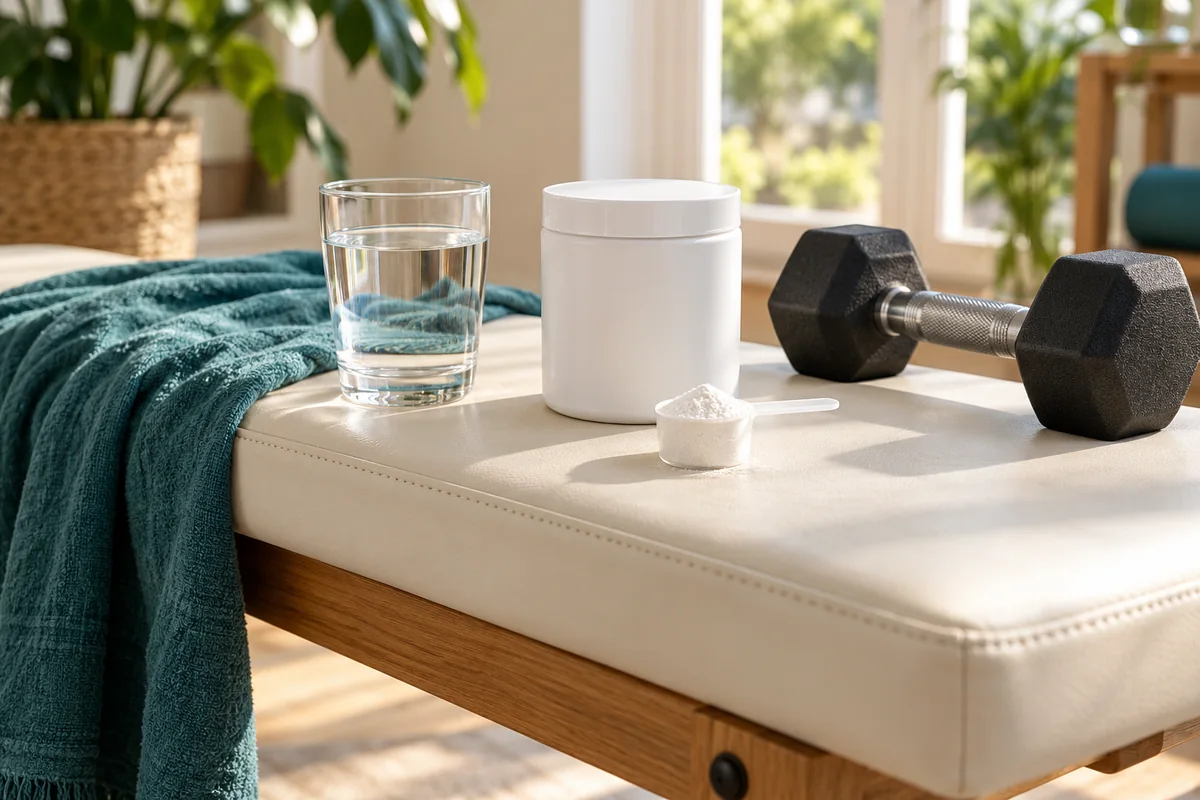
The supplied listing identifies Nutricost Micronized Creatine Monohydrate Powder, unflavored, in a 500 g container marketed as 100 servings of 5 g. Those are product-listing details. “Micronized” describes particle processing, not proof that the product gives greater training gains than ordinary creatine monohydrate. This guide evaluates the ingredient and practical decision; it does not claim that we personally tested the tub or independently verified every manufacturer quality statement.
What happens in muscle and why the activity matters
The body stores creatine, much of it in skeletal muscle, and uses the creatine/phosphocreatine system to help rapidly replenish ATP during short, demanding efforts. Supplementation can increase available stores. The mechanism fits activities such as repeated heavy sets or short intense efforts more directly than the idea of unlimited energy throughout an ordinary day. NIH ODS: Creatine and athletic performance.
Think about your training demands before expecting an effect. Someone gradually learning resistance exercises has a different starting point from an experienced athlete trying to improve repeated efforts. The supplement can be considered within either situation, but technique and an appropriate program still determine what you practice. A mechanism also does not establish that every person experiences the same size of benefit. Differences in baseline stores, diet and training can influence the response.
The clearest benefits belong to a defined context
The International Society of Sports Nutrition’s position stand reviews evidence supporting creatine monohydrate for high-intensity exercise capacity and lean-mass gains during training. It also distinguishes the substantial monohydrate evidence base from claims made for alternative forms. ISSN position stand on creatine, 2017. This is not a promise that adding a scoop to an unchanged lifestyle produces a particular physique.
A useful expectation is a possible improvement in the work you can repeat and the adaptations associated with an appropriate training plan. Keep that distinct from endurance claims, fat loss, general motivation or treatment of a medical condition. Creatine research covers many additional questions, but a favorable result in one population cannot automatically validate every emerging claim. When a headline jumps from a muscle-energy mechanism to guaranteed cognitive or longevity benefits, ask for the relevant human outcomes and limitations.
Studied amounts are educational context, not a personal prescription
Common adult research and sports-nutrition approaches include a maintenance intake of roughly 3–5 g per day. Some studies use a short loading period followed by maintenance, while lower daily intake can also raise muscle stores over time without that loading phase. Loading is not required for every person. ISSN: Creatine protocols studied in sport. The linked product’s stated 5 g serving is within a commonly studied range; that does not make it appropriate for every reader.
The practical distinction is between describing evidence and telling someone what they must take. Review the product label and relevant medical advice. Avoid combining several scoops because a workout felt difficult or because a different product used a different serving. A kitchen scale may help check a powder quantity, while the included scoop is a convenience tool. Do not use animal or clinical-disease research to improvise much larger amounts for ordinary training.
Consistency is more useful than complicated timing rules
If you and an appropriate professional decide creatine fits your circumstances, choose a manageable routine and follow the agreed amount. The routine should be easy to remember on days when you train and days when you do not. There is no need to turn taking a powder into the most complicated part of your program. A special drink, expensive stack or elaborate cycling schedule should not be treated as a prerequisite.
Record when you start and what else changes. If you alter your training, protein intake, sleep and supplement use at once, it becomes harder to interpret any result. Keep your actual training log: exercise, resistance, repetitions and how the work felt. That information is more helpful than deciding after one session that a product either transformed your performance or failed. Our beginner strength routine offers a simple framework to adapt before adding more complexity.
Understand body-weight changes and common misinterpretations
Creatine can increase body weight through additional water associated with muscle creatine storage, especially early in use. A scale change is not automatically a gain in body fat. Conversely, a sudden increase in lean mass on a device should not all be described as newly built contractile muscle. NIH and the sports-nutrition literature discuss water-related weight changes and gastrointestinal complaints. NIH ODS: Creatine effects and safety considerations.
This matters if you compete in a weight-category sport or become anxious when weight fluctuates. Decide beforehand whether that possible change fits your goals and whether tracking weight is helpful for you. If a product causes digestive symptoms, do not assume that enduring them is necessary for progress. Review the amount, preparation and suitability with qualified guidance. Unexpected or persistent symptoms deserve assessment rather than being labeled a harmless effect from a supplement article.
Who needs individual medical guidance?
The safety evidence in generally healthy adults is more reassuring than many popular rumors suggest, but that is not a blanket assurance for every clinical circumstance. Kidney disease, relevant medicines, pregnancy, breastfeeding and other medical situations call for individualized advice. Tell your clinician about use before interpreting laboratory tests. Creatine-related changes in creatinine can complicate interpretation without necessarily proving kidney injury; a clinician should assess the whole picture. Antonio and colleagues: Common questions and misconceptions about creatine, 2021.
This publication is for adults and is not a youth supplementation protocol. Do not use it to override a treating professional or a sports organization’s rules. Keep supplement packaging and share the actual ingredient list rather than saying only that you use a workout powder. If you already take a multi-ingredient pre-workout, check whether it also supplies creatine. Accidental duplication can make your intended intake harder to track and adds no automatic value.
Choose a simple product and compare the usable cost
A clearly labeled single-ingredient creatine monohydrate powder is easier to evaluate than a proprietary performance blend. Ask whether the product identity and relevant quality claims can be independently checked. For tested athletes, use the exact applicable certification records rather than assuming that any third-party test addresses banned-substance risk. NSF’s directory allows product-specific searches; no certification should be transferred from one product to another. NSF Certified for Sport product directory.
Compare cost per measured serving and the form you will actually use. Flavoring, special terminology or a larger tub is not a clinical advantage. Count total servings from the current label and remember that marketplace prices change. Decide whether the benefit is worth the ongoing cost after your basic training and food plan are covered. You can use our nutrition tools to understand meals if tracking is comfortable, but a consistent program and adequate food remain more important than optimizing the name of your powder.
The supplied product: label details and open questions
Nutricost Micronized Creatine Monohydrate, unflavored, 500 g
Retailer identity and label descriptions were checked October 19, 2026. They are not clinical evidence, proof of an authentic delivered batch, or results from personal product testing. Packaging can change.
| Listing identity | Amazon ASIN B00GL2HMES |
|---|---|
| Serving or specification | The listing specifies 5 g creatine monohydrate per scoop, 100 servings per 500 g container. A loading schedule is not necessary for every appropriate use. |
| Composition or material | The unflavored listing identifies micronized creatine monohydrate. Do not transfer this ingredient list or serving to flavored or Creapure-branded variants. |
| Testing and certification | Independent certification and current batch-specific laboratory results for this exact supplied item were not confirmed. Manufacturer or retailer testing claims are not treated as independent verification. |
If the category fits a genuine need, you can inspect the Nutricost Micronized Creatine Monohydrate, unflavored, 500 g listing and current label on Amazon (affiliate link). Compare it with the evidence and alternatives above; this is an optional label-comparison link, not a claim that we tested or clinically validated the product.
Questions readers commonly ask
Do I need a loading phase?
Not necessarily. Loading is one studied way to increase stores more rapidly, while a smaller ongoing daily amount can work over time. The choice is not a requirement to copy the largest protocol online.
Is micronized creatine a different active ingredient?
It is creatine monohydrate processed into smaller particles. The description does not by itself prove greater strength or muscle gains than another appropriate monohydrate product.
Can I gain muscle without creatine?
Yes. Creatine is optional. Suitable resistance training, recovery and sufficient nutrition remain the foundation; the supplement does not replace them.
Affiliate reminder: this article includes an Amazon affiliate link. As an Amazon Associate I earn from qualifying purchases. Buying a product is not required to benefit from this guide.
Sources & references
- NIH Office of Dietary Supplements: Dietary Supplements for Exercise and Athletic Performance. Source link checked October 19, 2026.
- Kreider RB, Kalman DS, Antonio J et al.: International Society of Sports Nutrition position stand: safety and efficacy of creatine supplementation in exercise, sport, and medicine. 2017. Source link checked October 19, 2026.
- Antonio J, Candow DG, Forbes SC et al.: Common questions and misconceptions about creatine supplementation: what does the scientific evidence really show?. 2021. Source link checked October 19, 2026.
- NSF Certified for Sport: Certified Products Search. Source link checked October 19, 2026.
- Amazon product listing: Nutricost Micronized Creatine Monohydrate, unflavored, 500 g (retailer description, not efficacy evidence). Source link checked October 19, 2026.
Research can change. These sources support the claims cited in this article, rather than every suggested example. Our action plans are adaptable editorial examples.

Jordan Ellis
A fictional editorial persona focused on accessible movement, beginner strength training, and gradual progress.
Fictional editorial persona · AI generated portrait · No clinical credentials