What to take away
- Expect possible short-term comfort or movement changes, not guaranteed tissue repair.
- Do not use percussion on vulnerable structures, suspected clots, or unexplained symptoms.
- The device is optional; sound training and recovery habits remain the foundation.
General education for adults. AI assisted content; not professionally medically reviewed. Sources are linked throughout. For advice about your health, speak with a qualified clinician. Our editorial policy.
This article contains affiliate links. As an Amazon Associate I earn from qualifying purchases. Links are optional and do not change our interpretation of evidence.
A comfort tool, not a diagnosis or repair service
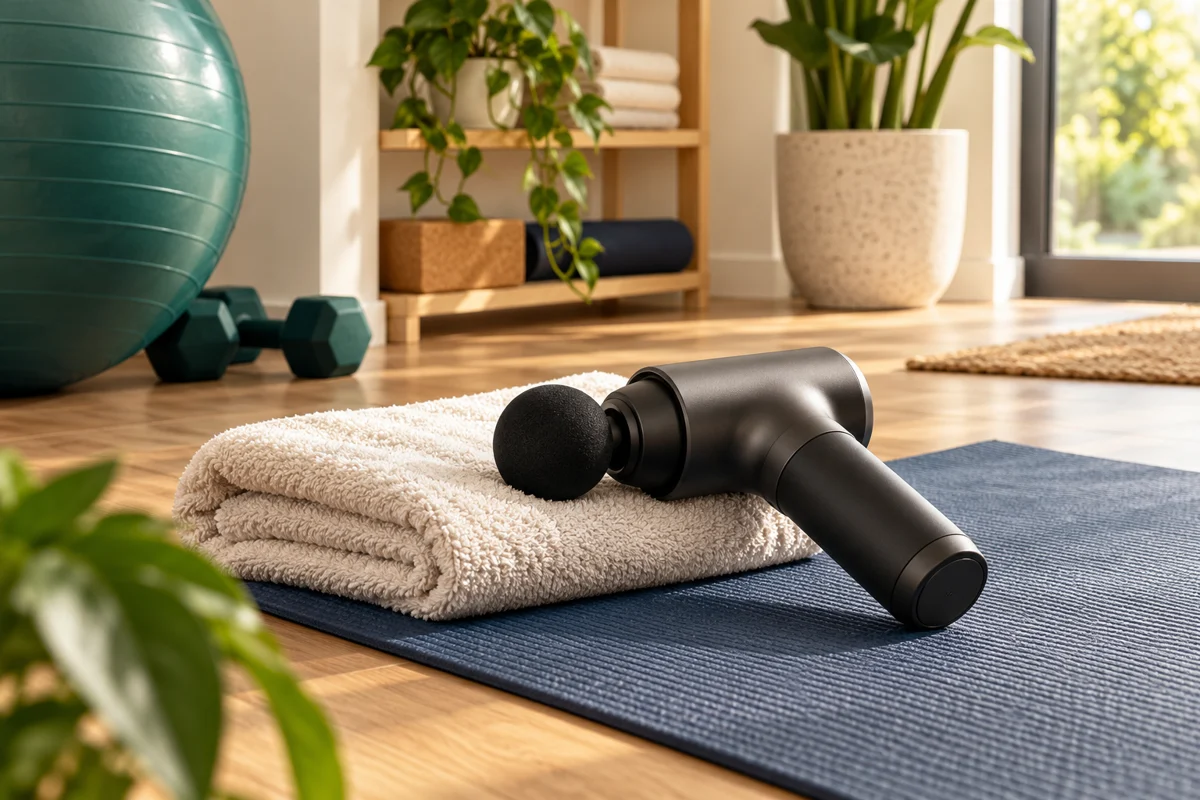
A massage gun applies repeated mechanical pulses to an area of soft tissue. Some people find the sensation relaxing or notice a short-term change in comfortable movement. That is a reasonable description of a possible use; claims that it repairs injuries, flushes toxins, dissolves scar tissue, or guarantees faster recovery go beyond what should be assumed. The device cannot tell whether soreness is ordinary or whether pain needs medical assessment.
The supplied listing identifies a TOLOCO massage gun. Its attachments, speed labels, battery information, and instructions should be verified on the exact delivered model. This article has not independently tested the device’s force, sound, safety systems, or advertised performance. More attachment heads or a stronger setting do not establish a better health outcome. The decision begins with whether the intended use is appropriate at all.
What the current evidence can reasonably support
A systematic review of massage-gun research found potential short-term benefits for some range-of-motion and recovery-related outcomes, while noting a limited and varied evidence base. Systematic review: massage guns, performance, and recovery Another review considered performance and pain findings across small studies. Systematic review of percussive therapy Neither establishes a single ideal protocol for every person, body area, or consumer device.
Keep the outcome precise. Feeling less stiff is not proof that tissue has healed or that a muscle can safely tolerate more load. A movement test immediately after treatment is not the same as fewer injuries over a season. Research in healthy adults also cannot automatically be extended to a new injury, a neurological condition, or unexplained pain. That distinction protects you from turning an optional comfort purchase into a substitute for care.
Why mixed trial results matter
One calf study found an immediate range-of-motion improvement after a defined percussion treatment without an accompanying strength improvement. Konrad and colleagues: plantar-flexor range of motion and performance In another study, a post-exercise treatment had little effect on several measured recovery outcomes. Under the Gun: recovery study in active adults Different protocols and outcomes can produce different results; those findings are not contradictory proof that every device is either essential or useless.
A practical interpretation is to judge the tool against a modest, observable aim: does a gentle, appropriate use make a familiar movement feel more comfortable without causing symptoms? Do not interpret a pleasant sensation as permission to skip sleep, food, rest, or a sensible training program. You should be able to stop using the device without believing that your whole recovery process will fail.
Who might use one, and who should obtain advice first
A generally healthy adult with ordinary muscle tightness may consider a massage gun as an optional comfort tool after reading the manual. A person with a current injury or an unexplained symptom has a different decision to make. If the location is painful, swollen, bruised, numb, unusually warm, or progressively worsening, assess the cause rather than trying to overpower the sensation.
Ask a treating clinician before use if you take blood-thinning medicine, have a bleeding disorder, reduced sensation, fragile skin or bones, a recent operation, a known clotting problem, or a condition affecting nerves or circulation. Follow advice about implants, pregnancy, and other individual circumstances. These are screening questions, not a complete list of contraindications for every device. The absence of a diagnosis is not proof that a particular painful area is safe to treat.
Keep the device away from vulnerable structures
Do not apply a massage gun over the front or side of the neck, the head, the spine, the throat, an open wound, a fresh injury, or a visibly swollen or inflamed area. Avoid joints, bony prominences, and locations where pressure causes tingling or numbness. Do not aim to press deeply into areas containing major vessels or nerves. If you cannot identify a suitable muscle area confidently, obtain instruction rather than experimenting.
Never use it to treat a suspected blood clot. A newly swollen, painful leg or another concerning circulation symptom requires medical assessment, not massage. Emergency symptoms such as sudden breathlessness or chest pain require urgent help. Percussion reviews discuss precautions and the limited evidence for clinical use. Review: evidence and safety considerations A consumer device should not be used to delay care for a problem whose cause has not been established.
Use the least aggressive approach that is comfortable
Read the exact manual, choose an approved attachment, and begin at the lowest comfortable setting if use is appropriate. Keep contact light and the head moving over a suitable muscle area; do not dig in to force a change. Avoid a universal time prescription, because the device, location, health situation, and research protocols differ. Follow manufacturer limits and any clinician’s advice.
Stop for pain, bruising, dizziness, tingling, numbness, skin irritation, or worsening symptoms. Do not use the device while driving, falling asleep, or doing another task that prevents you from monitoring the sensation. If reaching the area makes you twist awkwardly, ask whether an alternative is more suitable. A harder-to-reach muscle is not a reason to hold the gun against your neck or balance unsafely to reach your back.
Put it in a recovery routine that works without the device
After training, first check the ordinary factors you can influence: the amount of work performed, the time until the next demanding session, adequate meals, and enough opportunity for rest. A massage gun cannot undo an abrupt increase in training load. If the same area repeatedly hurts, review technique and programming instead of increasing percussion strength.
You might prefer a comfortable walk, a gentle movement break, or simply time between sessions. A massage gun is not required to earn the benefits of exercise. Our beginner strength guide helps place sessions in a realistic week, while the return-to-activity guide emphasizes a manageable starting point. General exercise-safety guidance supports building gradually and responding to pain rather than forcing activity. AAOS: safe exercise
Quality and ownership questions before buying
Look for a clear manual, a traceable supplier, compatible charging equipment, warranty information, and a way to obtain support. Check the model in the CPSC recall and safety-warning database. Examine the charger, cable, casing, and attachment connection on delivery. Stop using a device with damaged electrical parts, unusual overheating, a loose head, or another defect, and contact the supplier.
Compare practical features you can verify rather than treating advertised stall force, amplitude, or speed as a clinical ranking. A comfortable grip and the ability to operate the device without excessive pressure may matter more than a long list of settings. Ask where the manufacturer’s safety instructions can be read before purchase. Clean attachments according to those instructions, let them dry as directed, and do not share equipment in a way that ignores skin or hygiene concerns.
An everyday decision example
Suppose your calves feel mildly tight after a familiar walk, but there is no swelling, injury, unusual warmth, or change in sensation. You could first choose a comfortable movement break and see whether ordinary rest is enough. If you already own a massage gun and its instructions permit the use, light, comfortable contact might be an optional choice. Now change the example: one calf becomes newly swollen and painful. The right decision changes too. That situation needs medical assessment rather than a device experiment. The same product is not appropriate simply because the body part is the same; the symptoms and context determine the next step.
The supplied product: label details and open questions
TOLOCO EM26 massage gun, black
Retailer identity and label descriptions were checked October 19, 2026. They are not clinical evidence, proof of an authentic delivered batch, or results from personal product testing. Packaging can change.
| Listing identity | Amazon ASIN B083L8RNJR |
|---|---|
| Serving or specification | The listing identifies model EM26 with ten attachments and adjustable speeds. Advertised amplitude, battery life and noise are not independently tested performance results. |
| Composition or material | This is a percussion massage device, not a medication. Check the manual, approved body areas, charger, attachments and current model instructions. |
| Testing and certification | Independent certification and current batch-specific laboratory results for this exact supplied item were not confirmed. Manufacturer or retailer testing claims are not treated as independent verification. |
If the category fits a genuine need, you can inspect the TOLOCO EM26 massage gun, black listing and current label on Amazon (affiliate link). Compare it with the evidence and alternatives above; this is an optional label-comparison link, not a claim that we tested or clinically validated the product.
Common questions
Should massage hurt to work? No. Pain is not a target. If light contact is uncomfortable, stop and reassess the area. Increasing pressure to chase relief may make it harder to notice a developing problem.
Can it replace warming up? No. A brief change in comfortable range is not the same as preparing for a task or practicing its technique. Use an appropriate warm-up and a sensible training load whether or not you use percussion.
How do I know it is helping? Define a modest aim, such as comfort during a familiar gentle movement, and notice whether any benefit occurs without unwanted effects. Persistent pain, swelling, weakness, or altered sensation needs assessment rather than repeated experiments with a stronger setting.
Affiliate reminder: this article includes an Amazon affiliate link. As an Amazon Associate I earn from qualifying purchases. Buying a product is not required to benefit from this guide.
Sources & references
- Ferreira RM, Silva R, Vigário P et al.: The Effects of Massage Guns on Performance and Recovery: A Systematic Review. 2023. Source link checked October 19, 2026.
- Sams L, Langdown BL, Simons J et al.: The Effect Of Percussive Therapy On Musculoskeletal Performance And Experiences Of Pain: A Systematic Literature Review. 2023. Source link checked October 19, 2026.
- Under the Gun: Percussive Massage Therapy and Physical and Perceptual Recovery in Active Adults. 2024. Source link checked October 19, 2026.
- Konrad et al.: The Acute Effects of a Percussive Massage Treatment with a Hypervolt Device on Plantar Flexor Muscles’ Range of Motion and Performance. 2020. Source link checked October 19, 2026.
- American Academy of Orthopaedic Surgeons: Safe Exercise. Source link checked October 19, 2026.
- U.S. Consumer Product Safety Commission: Recalls and Product Safety Warnings. Source link checked October 19, 2026.
- Amazon product listing: TOLOCO EM26 massage gun, black (retailer description, not efficacy evidence). Source link checked October 19, 2026.
Research can change. These sources support the claims cited in this article, rather than every suggested example. Our action plans are adaptable editorial examples.

Jordan Ellis
A fictional editorial persona focused on accessible movement, beginner strength training, and gradual progress.
Fictional editorial persona · AI generated portrait · No clinical credentials