What to take away
- Check the exact manual, footprint, clearance, and floor before purchase.
- A stable, controlled progression matters more than a first-day pull-up.
- Weight-capacity marketing does not authorize swinging or improvised attachments.
General education for adults. AI assisted content; not professionally medically reviewed. Sources are linked throughout. For advice about your health, speak with a qualified clinician. Our editorial policy.
This article contains affiliate links. As an Amazon Associate I earn from qualifying purchases. Links are optional and do not change our interpretation of evidence.
A tower is useful only if the person, space, and structure fit
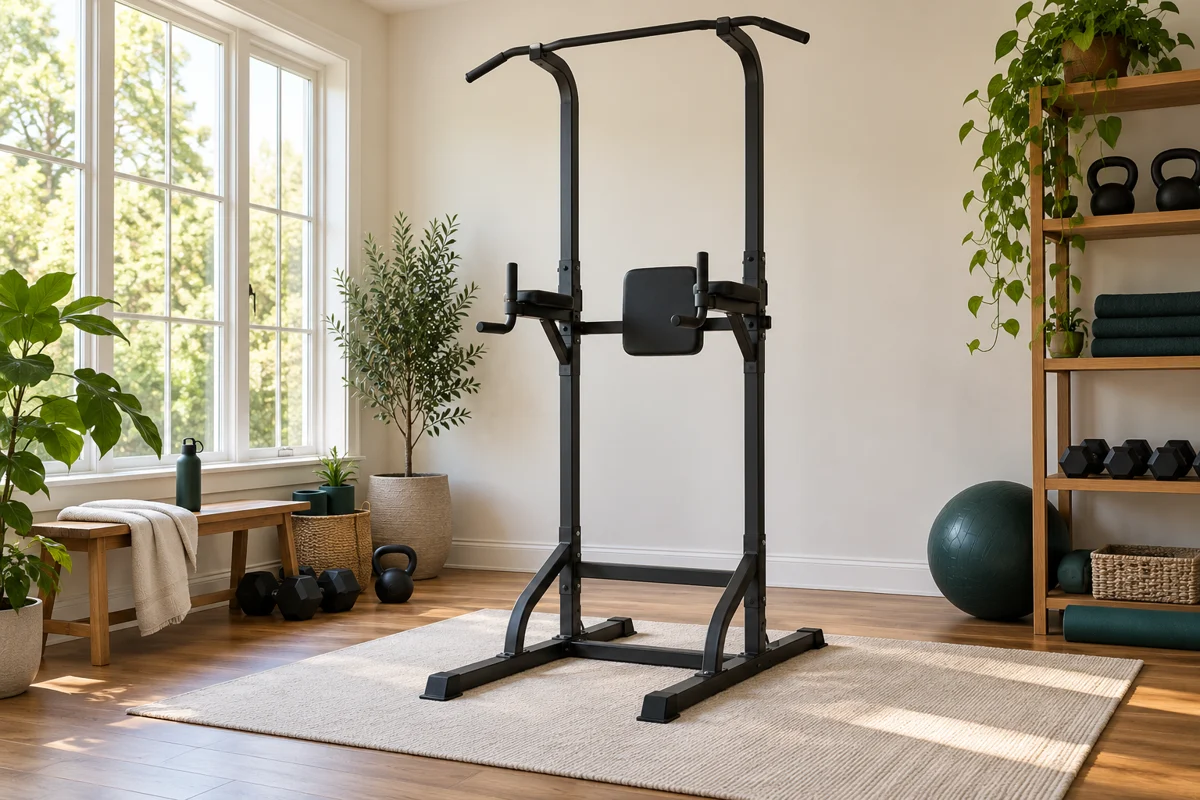
A pull-up tower can make vertical pulling and other supported body-weight exercises available at home. It can also be an expensive obstacle if the room is too small, the structure moves, or the exercises are currently beyond your capacity. The first question is not how many movements the advertising photograph shows. Ask whether the exact equipment can be assembled correctly and used safely for the few movements you need.
The supplied link identifies a SPORTSROYALS tower listing. Any claimed weight capacity, frame design, adjustments, or dimensions must be checked in the current manual and actual delivered model. This article does not independently load-test the tower or confirm its suitability for a particular floor. A high advertised weight limit is not permission to swing, attach extra equipment, or ignore an unstable base.
What pull-up research tells us, and what it does not
Pull-ups and chin-ups involve several upper-body muscles rather than isolating a single area. Electromyographic research has compared muscle activity and elbow motion across variations. Youdas and colleagues: pull-up and chin-up muscle-activity study Such measurements help explain movement demands; they do not prove that one retail tower produces superior muscle growth, that a grip is best for every shoulder, or that beginners should start with full repetitions.
Muscle activation is not the same outcome as long-term strength, comfort, or injury risk. A useful home program still requires suitable effort, a manageable amount of work, and time to adapt. You can train effectively without completing a full pull-up on the first day. Equipment should serve your current training level while offering a sensible path forward, rather than functioning as a test you must pass before you are allowed to exercise.
Measure the room before ordering
Check the full footprint, not only the distance between the uprights. Include clearance for your body, a controlled dismount, nearby walls, ceiling fixtures, and any moving parts. Measure the ceiling at the intended location and compare it with both the tower and the space your head may need above the bar. Do not rely on a room photograph with no scale.
Consider storage, household traffic, children, pets, and whether another person may pass through the exercise area. The floor should meet the manufacturer’s requirements. A soft or uneven surface can change stability; adding a cushion underneath is not an assumed fix. If the equipment will live in a rental, shared room, or upstairs space, review practical access and noise questions before purchase. A setup that must be rebuilt for every session may be difficult to use consistently.
Assembly and inspection are part of the workout plan
Inventory parts, use the specified hardware and tools, and follow the sequence in the manual. Do not substitute bolts, skip bracing, or decide a leftover piece was unnecessary. If a fastener cannot be installed as directed, contact the supplier before loading the frame. Keep the manual and model number somewhere you can find them later.
Before each session, check for loose connections, movement at the base, damaged grips, and objects in the dismount area. Review the exact product in the CPSC recall and product-safety warning database without assuming a missing listing establishes safety. If the tower shifts during an exercise, stop rather than compensating by moving faster. Inspect and resolve the cause according to the manual; a training plan should never depend on hoping the frame will remain upright.
Begin with movements you can control
A beginner may first need a different exercise, such as a suitably coached row or an assisted pulling movement on equipment designed for it. Do not assume that a footrest, side rail, or arm support is an approved standing platform. Likewise, do not attach assistance bands or suspension devices unless the manufacturer specifically permits the setup. A convenient-looking connection can impose a load the structure was not designed to handle.
When a pull-up variation is appropriate, a qualified coach can help with grip, shoulder position, range, breathing, and a safe way to get on and off the bar. You should not have to leap toward an uncertain grip or drop into an obstructed space. Full dips, hanging leg raises, and prolonged hangs are separate tasks with their own demands. The presence of handles does not mean every advertised movement is the right starting exercise for you.
Progress without turning every set into a maximum attempt
Choose a small number of repeatable tasks and record how they were performed. For pulling work, note the assistance method, range, repetitions, and whether the setup remained stable. An easier version completed with control provides more useful information than several strained attempts whose technique changes each time. Our beginner strength routine shows how upper-body work can sit within a broader plan.
The ACSM progression position stand describes adjusting resistance-training demands as capacity improves. ACSM guidance on resistance-training progression That does not require maximum testing at home. An editorial starting principle is to improve consistency and control before adding difficulty. Avoid adding external weight simply because body-weight repetitions have improved; first verify equipment permissions and get appropriate programming advice. Keep enough recovery between demanding sessions to assess how your joints and muscles respond.
Why swinging and kipping require a different judgment
A swinging pull-up changes the movement and loads compared with a controlled repetition. Research examining kipping shows altered movement and muscle-activation patterns; it is not evidence that the technique is appropriate on any freestanding tower. Study of adding a kipping action during pull-ups Do not transfer a gym or gymnastics demonstration to home equipment without checking both coaching suitability and manufacturer restrictions.
Keep the tower within the intended uses. Avoid sideways rocking, improvised climbing, jumping between handles, or attaching loads that are not allowed. If you want advanced dynamic training, choose a supervised environment and equipment designed for that activity. The same caution applies when another person suggests holding the frame down. A helper’s body weight does not convert an unstable setup into a tested installation, and it may place that person in the path of a moving frame.
Fit the tower into whole-body health, not a single exercise identity
General adult activity guidance includes strengthening the major muscle groups on at least two days weekly. CDC adult activity guidance A pull-up tower does not cover that whole recommendation by itself. Legs, other upper-body patterns, suitable aerobic activity, and an accessible routine still matter. Consider whether a less costly gym membership, resistance band, or body-weight program would better fit your current goals.
Recent surgery, shoulder instability, persistent pain, significant balance problems, and conditions affecting exertion warrant individual advice before attempting demanding hanging exercises. General safe-exercise advice favors gradual preparation rather than abrupt overload. AAOS: safe exercise Stop for concerning pain, dizziness, or unusual symptoms. Severe chest symptoms, fainting, or major breathing difficulty require urgent help. Buying equipment does not replace assessment, and skipping a painful exercise is not a failure of motivation.
The supplied product: label details and open questions
SPORTSROYALS freestanding pull-up power tower
Retailer identity and label descriptions were checked October 19, 2026. They are not clinical evidence, proof of an authentic delivered batch, or results from personal product testing. Packaging can change.
| Listing identity | Amazon ASIN B07SM8VJ6P |
|---|---|
| Serving or specification | The listing claims a 450 lb capacity, H-frame base and adjustable height. These are seller specifications, not independently tested load limits or permission for swinging. |
| Composition or material | Alloy steel is the seller-described material. Confirm the manual, model, footprint, height, hardware, assembly and permitted exercises before use. |
| Testing and certification | Independent certification and current batch-specific laboratory results for this exact supplied item were not confirmed. Manufacturer or retailer testing claims are not treated as independent verification. |
If the category fits a genuine need, you can inspect the SPORTSROYALS freestanding pull-up power tower listing and current label on Amazon (affiliate link). Compare it with the evidence and alternatives above; this is an optional label-comparison link, not a claim that we tested or clinically validated the product.
Common questions
Is a tower worthwhile if I cannot do a pull-up? Possibly, but only if it offers approved exercises and a safe progression suited to you. Compare that with cheaper or more supervised options. Do not buy on the assumption that repeated failed attempts are a complete beginner program.
Does a high weight rating guarantee it will not tip? No. A capacity claim does not establish stability for every direction, speed, attachment, floor, or exercise. Follow the exact manual and stop if the frame moves unexpectedly.
Can I use it for kipping or weighted exercises? Only if the exact equipment is explicitly designed and permitted for those uses, and your training is appropriate. An online demonstration and a strong-looking frame do not establish either condition.
Affiliate reminder: this article includes an Amazon affiliate link. As an Amazon Associate I earn from qualifying purchases. Buying a product is not required to benefit from this guide.
Sources & references
- Youdas JW, Amundson CL, Cicero KS et al.: Surface electromyographic activation patterns and elbow joint motion during a pull-up, chin-up, or perfect-pullup™ rotational exercise. 2010. Source link checked October 19, 2026.
- U.S. Consumer Product Safety Commission: Recalls and Product Safety Warnings. Source link checked October 19, 2026.
- American College of Sports Medicine: American College of Sports Medicine position stand. Progression models in resistance training for healthy adults. 2009. Source link checked October 19, 2026.
- Dinunzio C, Porter N, Van Scoy J et al.: Alterations in kinematics and muscle activation patterns with the addition of a kipping action during a pull-up activity. 2019. Source link checked October 19, 2026.
- CDC: Adult Activity — An Overview. Source link checked October 19, 2026.
- American Academy of Orthopaedic Surgeons: Safe Exercise. Source link checked October 19, 2026.
- Amazon product listing: SPORTSROYALS freestanding pull-up power tower (retailer description, not efficacy evidence). Source link checked October 19, 2026.
Research can change. These sources support the claims cited in this article, rather than every suggested example. Our action plans are adaptable editorial examples.

Jordan Ellis
A fictional editorial persona focused on accessible movement, beginner strength training, and gradual progress.
Fictional editorial persona · AI generated portrait · No clinical credentials